

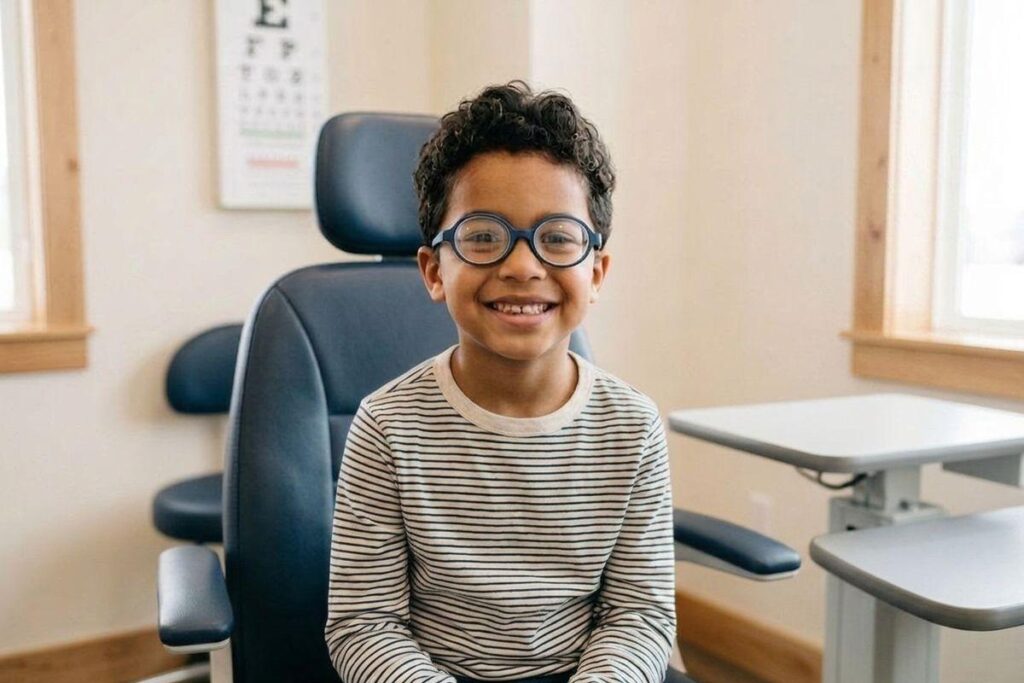
Seeing your child struggle to focus on faraway objects can be a stressful experience for any parent. You want to make sure they have the clear vision they need to thrive at school and play. Standard glasses and contacts correct blurry vision, but they don’t stop the eye from growing too long.
Myopia control is a set of treatments designed to slow how fast a child’s myopia progresses, with the goal of reducing their risk for serious eye problems down the road. Myopia isn’t just a vision inconvenience. It’s a long-term eye health concern.
How Myopia Progresses in Children and Teens
Myopia often shows up before a child turns 10. From there, it tends to get worse every few months through the teenage years, when the body, including the eyes, is still growing. When the eyeball grows too long from front to back, light focuses in front of the retina instead of directly on it. This causes distant objects to look blurry. It also increases the long-term risk for conditions like retinal detachment, glaucoma, and early cataracts in adulthood.
The earlier it starts, the more time it has to progress, which is why diagnosing it young matters. We can track how their prescription changes year over year to intervene at the right time.
What Makes Nearsightedness Worse?
No single habit causes this condition, but a few factors are linked to faster progression. Pay attention to these common factors:
- A lot of time spent on screens or doing close-up work like reading
- Less than two hours of outdoor time each day
- A parent or sibling who is nearsighted
Spending time outdoors, in particular, appears to have a protective effect on eye development. Natural light and looking at things far away give the eyes a break from the near-focus strain caused by screens and books.
What Myopia Control Actually Does
Standard glasses and contact lenses correct blurry vision, but they don’t slow how fast the eye grows. Myopia control treatments work differently by targeting the growth of the eye itself. They focus on a few key goals:
- Slowing how quickly the eye lengthens over months and years
- Keeping prescription changes from happening as rapidly
- Reducing the lifetime risk of eye disease tied to high myopia
Think of it this way. If your child’s prescription climbs from -1.00 to -6.00 by the time they finish school, their long-term eye health risk looks very different from what it would be if myopia control helped keep that number closer to -3.00. We may not be able to stop myopia completely, but we can slow it down.
Myopia Control Treatment Options
We offer a few different ways to manage your child’s vision. Our optometrists work with your family to find an option that fits your child’s needs, prescription, and routine.
Specialty Contact Lenses
Two types of contact lenses are commonly used for myopia control.
Multifocal soft contact lenses are worn during the day and are designed to reduce the stimulus that drives eye growth. Orthokeratology, or Ortho-K, uses rigid lenses worn overnight. They gently reshape the cornea while your child sleeps, so they may be able to see clearly during the day without glasses or daytime contact lenses.
A contact lens fitting helps determine which option fits your child’s lifestyle and prescription.
Atropine Eye Drops
Low-dose atropine drops are placed in the eye each night. They’re typically used for children between ages 5 and 18 and are one of the more studied approaches for slowing myopia progression. Low-concentration atropine drops help reduce side effects compared to older, higher-dose versions.

Lifestyle Habits That Support Treatment
Clinical treatments work better alongside some simple daily routines. Encourage your child to adopt these habits:
- Aim for about 2 hours of outdoor time each day
- Follow the 20-20-20 rule during screen use. Every 20 minutes, look at something 20 feet away for 20 seconds.
What Age to Start and What to Expect
Myopia control can be appropriate for children roughly between ages 6 and 18. Starting earlier, when there’s more growth ahead, gives us more opportunity to make a meaningful difference. Your optometrist can assess your child’s prescription history, eye measurements, and risk factors to help decide if and when to begin.
We track their progress through regular eye exams, typically every 6 to 12 months. These visits let us monitor how the eye responds and adjust the approach if needed.
Protect Their Vision for the Future
Comprehensive family eye care means your child gets a personalized plan instead of just a new prescription each year. We take the time to walk you through all available options and answer your questions at every visit.
Give your child the tools they need for lifelong healthy vision. Schedule an eye exam with Stonebridge Eye Care in Edmond and start managing their myopia today!